Illustration brief the model wrote
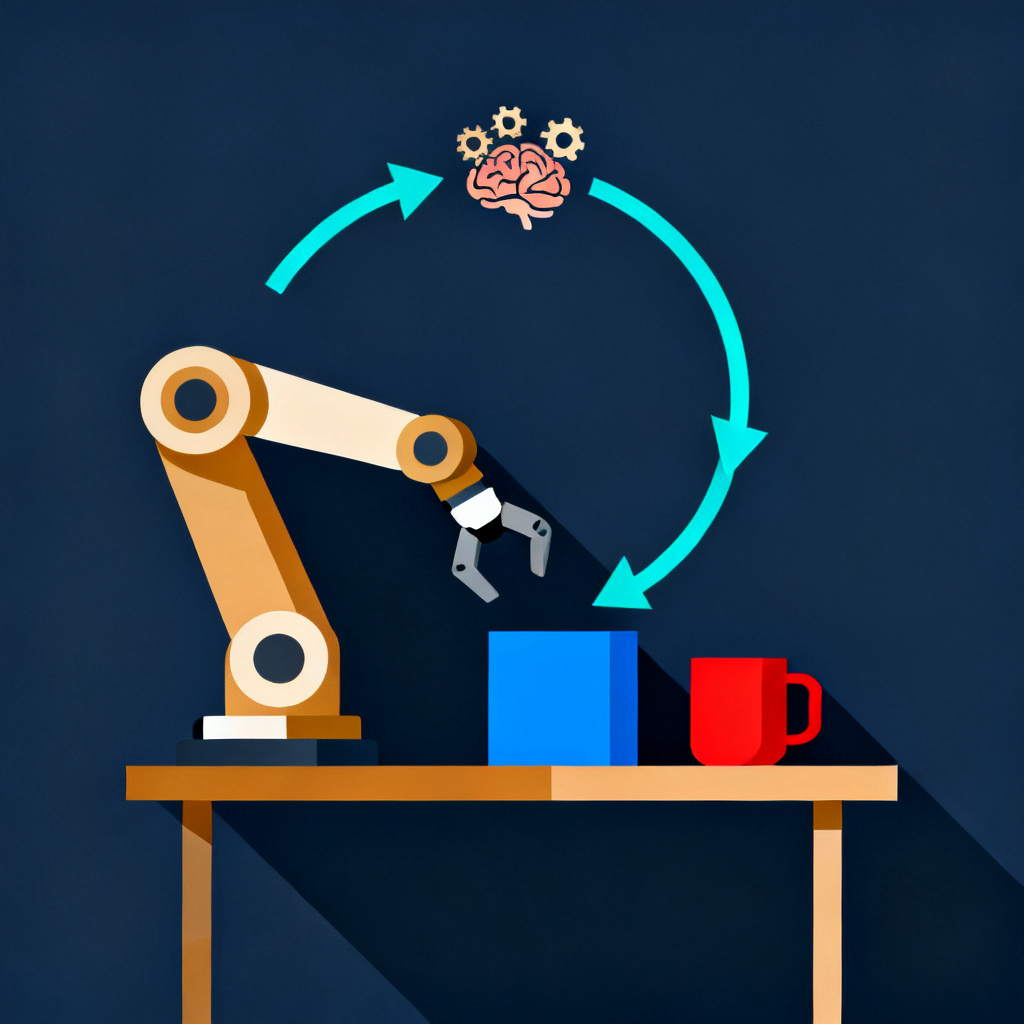
A single robot arm reaches toward a table holding a blue block and a red mug. Above the arm, a circular arrow loops from the gripper back to a small icon of a brain or gears, symbolizing self-generated practice data. No text or logos.
RoboCat: A Self-Improving Foundation Agent for Robotic Manipulation
A generalist agent that adapts to new robotic tasks from ~100 demos and self-improves by generating its own practice data.
What changed
ModelBefore RoboCat, robot learning typically required large datasets or manual data collection per task, and models rarely improved autonomously. This paper showed that a single agent can adapt to novel tasks and robot embodiments with very few demonstrations, then generate its own training data through self-practice, compounding its skills across successive tasks.
So what, in plain English
ModelRoboCat learns a new job after watching it done just 100 times, then practices on its own to get better, just like a musician who learns a new song from sheet music and then improves through repeated play.
Contribution to industry
ModelThis paper validated that self-generated data can drive rapid skill acquisition, enabling robot teams to cut the cost of adding a new task by allowing the model to train itself. It laid groundwork for autonomous data loops used in foundation models for robotics, and its approach influences how DeepMind and others now build generalist manipulation agents that improve in deployment.
Typed judgments
Jev★★★★☆ robots (also manipulation) · Physical AI 97%
Real hardware 70% · Open code / data 11% · Foundation-model based 71% · Survey / benchmark-only 3%
Probabilities from TypeSafe Jev over the title, venue and abstract; the filters on the atlas apply code-owned thresholds to these numbers.
Editor's notes
Summary. A generalist agent that adapts to new tasks and new robot embodiments from roughly 100 demonstrations, then generates its own training data to improve across successive tasks.
Industry. Showed self-generated data can compound robot skill learning, the basis for the self-improvement loops robot-model teams now use to cut cost per new task.