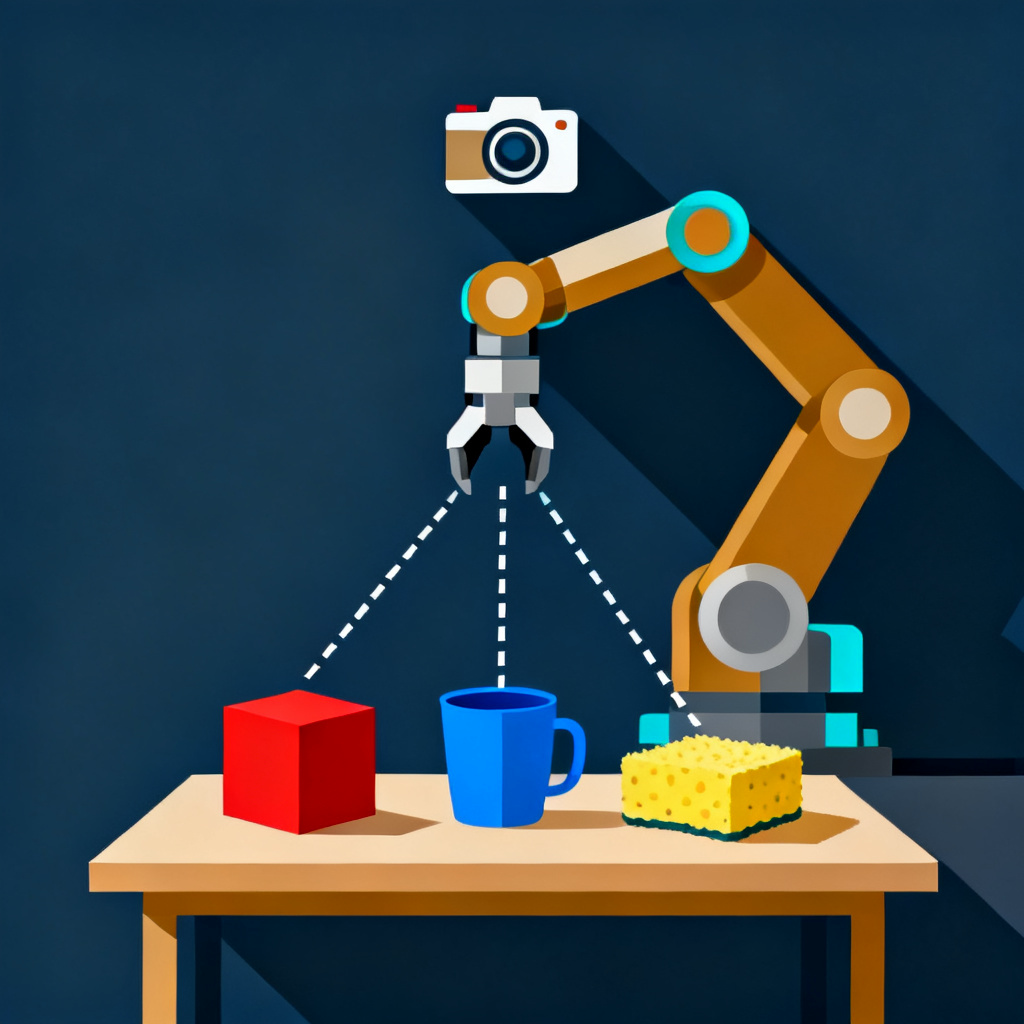
Illustration brief the model wrote
A robotic arm over a table with three distinct objects: a red cube, a blue cup, and a yellow sponge. Dashed lines from the gripper trace three different trajectories toward each object, with a camera icon above the arm. No text, letters, logos, or faces.
RT-1: Robotics Transformer for Real-World Control at Scale
A transformer policy trained on 130k robot episodes maps images and language to discretized actions for hundreds of tasks.
What changed
ModelBefore RT-1, robot control often required separate models or hand-tuned controllers for each task, limiting scalability. This paper showed that a single transformer trained on diverse real-world demonstrations can generalize across hundreds of manipulation tasks at practical control rates, replacing per-task pipelines.
So what, in plain English
ModelThink of it like a universal remote that works for every appliance instead of needing a different remote for each one. Before, robots needed a separate program for every chore; now one model can handle many different instructions by learning from lots of examples.
Contribution to industry
ModelRT-1 established the transformer architecture as the standard backbone for generalist robot policies, directly influencing follow-up systems like RT-2 and Open X-Embodiment. It enabled Google DeepMind and others to move toward unified deployment on real hardware, reducing the engineering cost of reprogramming for each new task.
Typed judgments
Jev★★★★★ robots · Physical AI 98%
Real hardware 92% · Open code / data 27% · Foundation-model based 33% · Survey / benchmark-only 2%
Probabilities from TypeSafe Jev over the title, venue and abstract; the filters on the atlas apply code-owned thresholds to these numbers.
Editor's notes
Summary. A transformer policy trained on about 130,000 real robot episodes that maps camera images and natural-language instructions to discretized actions across hundreds of tasks at high control rates.
Industry. The first widely replicated evidence that one large policy can replace per-task controllers, making it the architectural baseline for today’s robot-learning stacks.