Illustration brief the model wrote
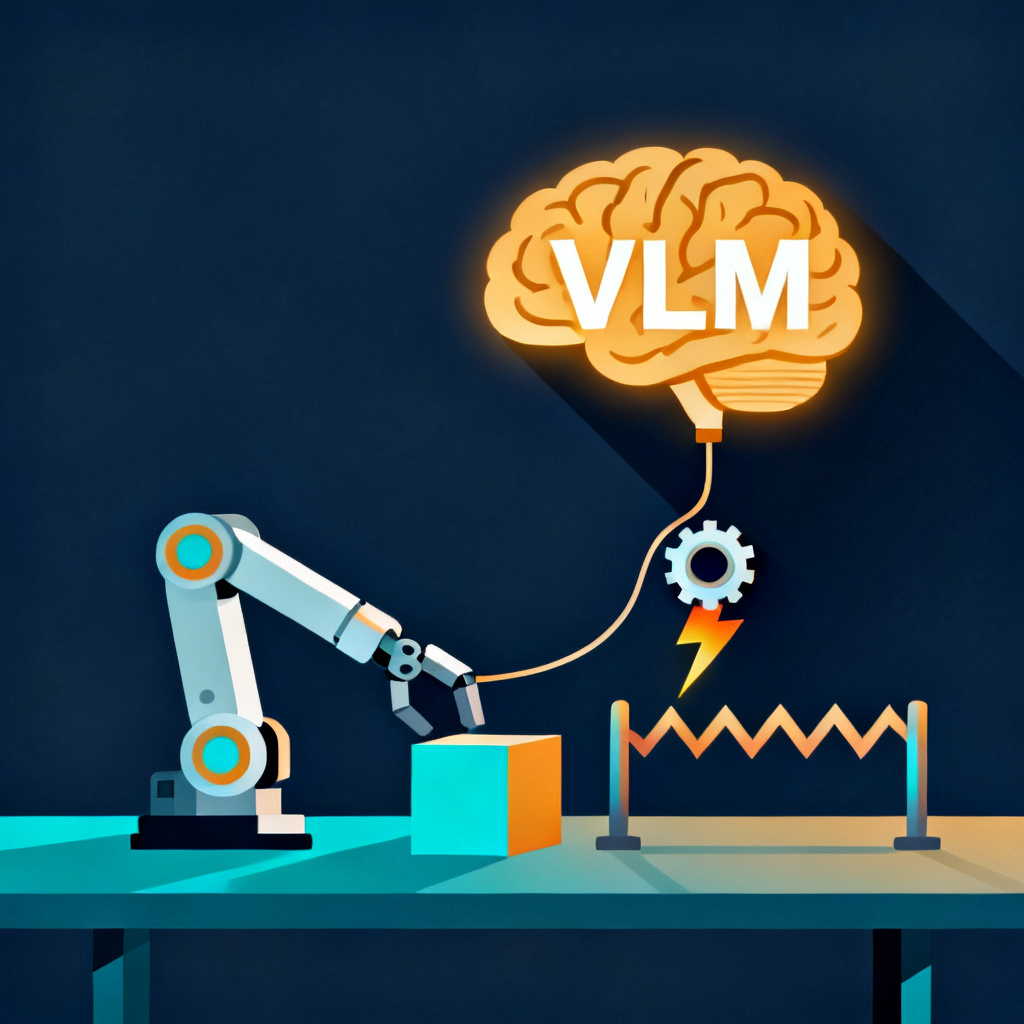
A robot arm reaches for a block on a table. Beside the arm, a large glowing brain icon (VLM) is connected by a thin insulated wire to a smaller gear icon (action expert). A lightning bolt gradient flows from the gear but is stopped by a zigzag insulator barrier before reaching the brain.
VLAs that Train Fast, Run Fast, and Generalize Better
Knowledge insulation stops action expert gradients from overwriting the VLM backbone, enabling fast training and strong generalization.
What changed
ModelBefore this paper, adding continuous action experts to a VLM often caused backward gradient interference that slowed training or eroded web-scale semantic knowledge. Knowledge insulation isolates these gradients, so the model trains as fast as tokenized VLAs while preserving language understanding and improving zero-shot generalization.
So what, in plain English
ModelImagine a chef who learns a new recipe without forgetting old techniques because the new instructions are kept in a separate notebook. This method lets robot models learn new physical skills quickly without losing the language and common sense they learned from the internet.
Contribution to industry
ModelThis work directly improves the training speed and deployment reliability of robot manipulation models, cutting compute cost and boosting language following in unseen environments. Physical Intelligence integrates it into their own VLA pipeline, and the technique can be adopted by any team building visuomotor policies on top of pretrained vision-language models.
Typed judgments
Jev★★☆☆☆ robots (also manipulation) · Physical AI 94%
Real hardware 48% · Open code / data 8% · Foundation-model based 95% · Survey / benchmark-only 6%
Probabilities from TypeSafe Jev over the title, venue and abstract; the filters on the atlas apply code-owned thresholds to these numbers.
Editor's notes
Summary. Knowledge insulation stops gradients from newly added continuous action experts from overwriting the VLM backbone, so the model trains as fast as tokenized VLAs while keeping web-scale semantic knowledge.
Industry. Gives robot teams faster VLA training plus better language following in unseen environments, a direct cost and reliability win for deployed manipulation.