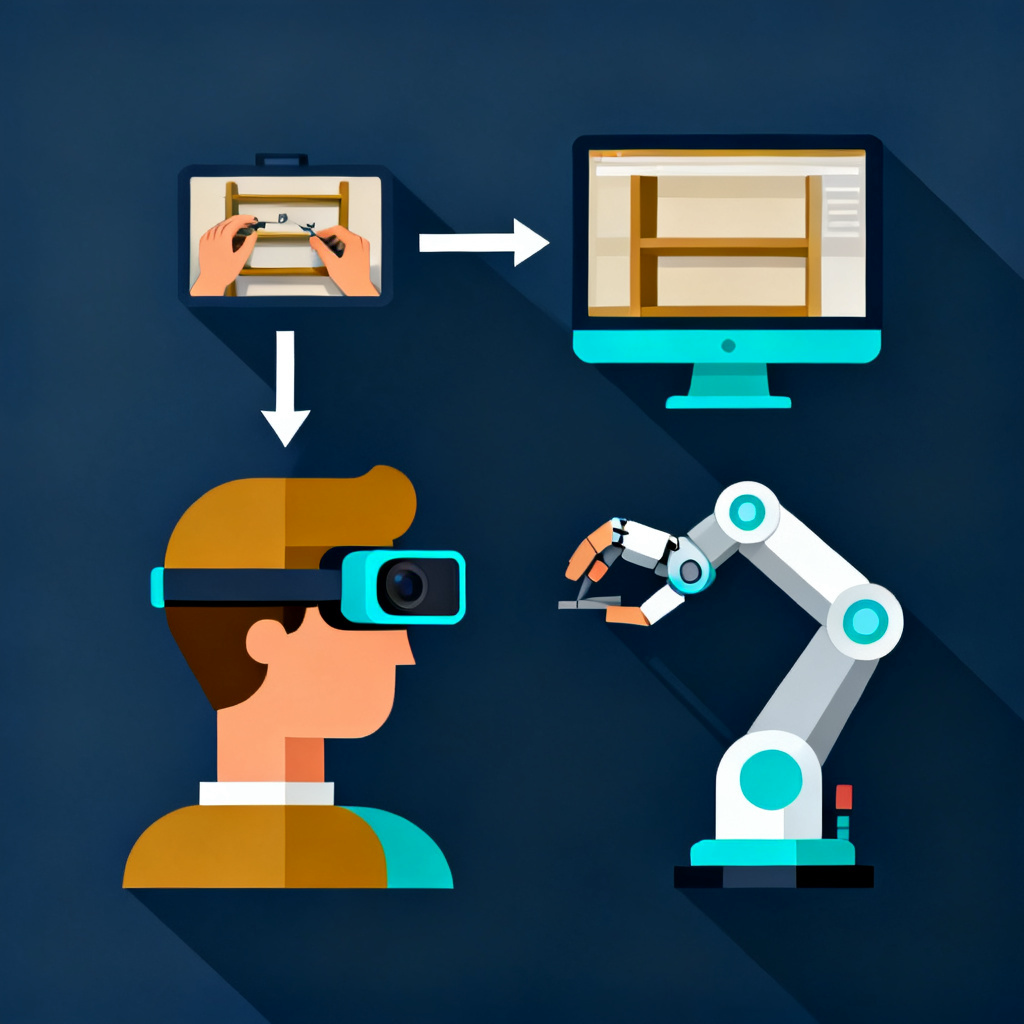
Illustration brief the model wrote
A head-mounted camera on a human shows an egocentric view of hands assembling a shelf. Next to the human, a robot arm mimics the hand movements. An arrow from camera to computer screen, then to robot, indicates data flow. No text, faces, or logos.
Emergence of Human to Robot Transfer in VLAs
Co-fine-tuning a scaled VLA on egocentric human video transfers to robot behavior, with emergence as robot data grows, improving 2x where scarce.
What changed
ModelBefore this paper, it was unclear whether human egocentric video alone could transfer to robot behavior in large VLAs, and robot data was expensive. This paper shows that simply co-fine-tuning on human video yields robot behavior, and that this transfer ability emerges as the amount of robot pretraining data increases. It makes cheap human video a viable source for improving robot skills, especially in data-scarce scenarios.
So what, in plain English
ModelImagine teaching a robot to cook by letting it watch you through a head-mounted camera. This paper shows the robot can learn from those videos, especially if it already knows other tasks from expensive demonstrations, so you can teach new tasks with cheap human videos.
Contribution to industry
ModelThis paper introduces a practical method to use cheap, wearable human video data to train robot VLAs, drastically cutting the required amount of expensive robot teleoperation data for new tasks. It enables faster scaling of robot deployment across diverse tasks by leveraging a widely available data source. Physical Intelligence can incorporate this into their VLA models to reduce data collection costs for real-world applications.
Typed judgments
Jev★★★☆☆ robots · Physical AI 96%
Real hardware 67% · Open code / data 10% · Foundation-model based 95% · Survey / benchmark-only 12%
Probabilities from TypeSafe Jev over the title, venue and abstract; the filters on the atlas apply code-owned thresholds to these numbers.
Editor's notes
Summary. Shows that simply co-fine-tuning a scaled VLA on egocentric human video transfers to robot behavior, and that this ability emerges as robot pretraining data grows, giving up to 2x improvement where robot data is scarce.
Industry. Turns cheap wearable human video into a usable industrial data source, shrinking how much expensive robot teleoperation a deployment needs to cover a new task.