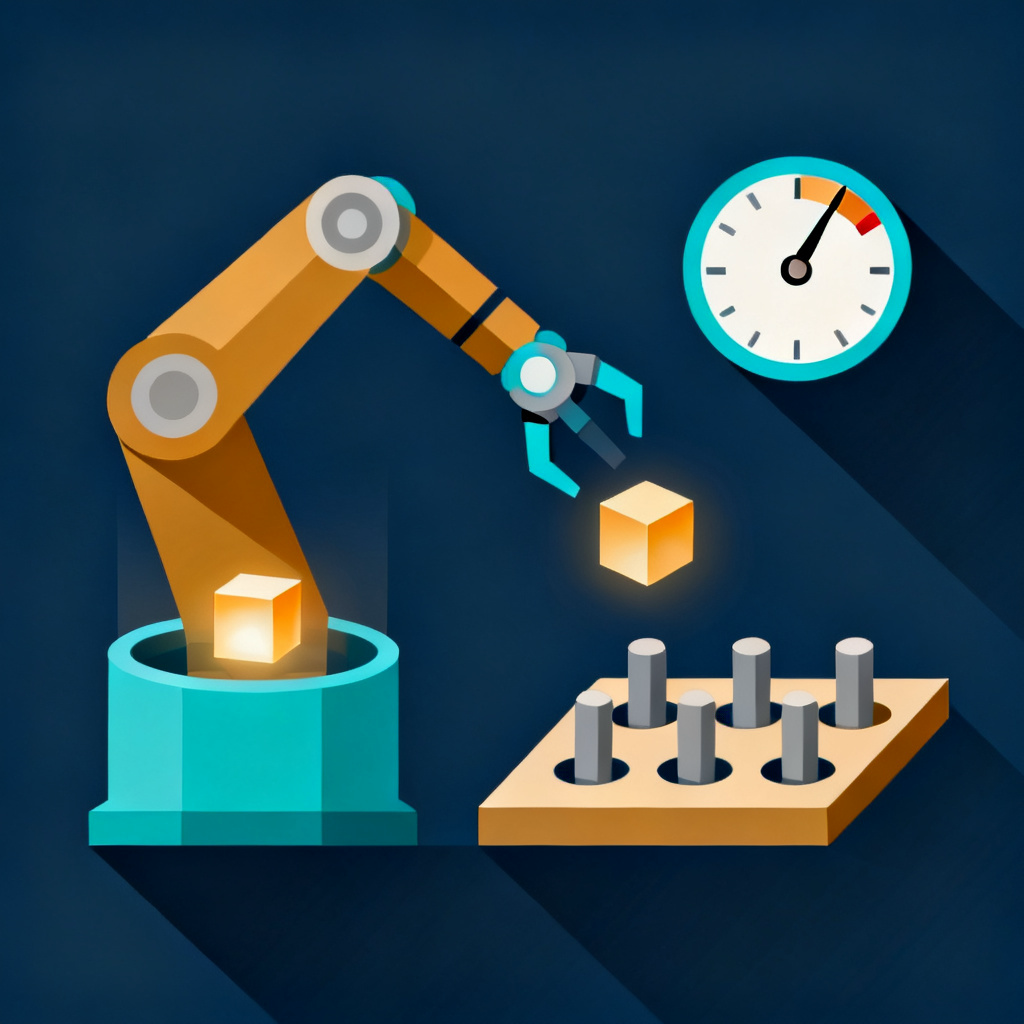
Illustration brief the model wrote
A robotic arm reaching toward a peg-in-hole assembly; a small glowing cube labeled 'RL token' floats inside the arm's base. A nearby speedometer needle points to '3x' and a clock icon shows '15 min'. No text, letters, or faces.
Precise Manipulation with Efficient Online RL
RL tokens compress VLA state for a tiny on-robot actor-critic, enabling fast online learning that speeds precise manipulation up to 3x from 15 minutes of data.
What changed
ModelPrior methods for fine-tuning dexterous manipulation required off-robot retraining or large amounts of online data. This paper introduces RL tokens, a compact representation of the vision-language-action model's internal state, allowing an efficient actor-critic to learn online directly on the robot and accelerate the most precise phases of tasks threefold with only about 15 minutes of real-world interaction.
So what, in plain English
ModelImagine a chef who can instantly tweak a recipe mid-cook instead of sending the dish back to the test kitchen. The robot uses a short practice session to learn millimeter-accurate adjustments on the spot, making it practical for real-world deployment where every factory line or job site is slightly different.
Contribution to industry
ModelPhysical Intelligence’s approach enables deployed robots to improve their own precision tasks without being returned to a research lab, reducing downtime and increasing autonomy. This is immediately relevant for manufacturing, assembly, and construction robots that must adapt to part tolerances or environmental variation on the line.
Typed judgments
Jev★★★☆☆ manipulation · Physical AI 97%
Real hardware 83% · Open code / data 7% · Foundation-model based 90% · Survey / benchmark-only 5%
Probabilities from TypeSafe Jev over the title, venue and abstract; the filters on the atlas apply code-owned thresholds to these numbers.
Editor's notes
Summary. RL tokens summarize the VLA’s internal state into a compact interface, letting a tiny on-robot actor-critic learn online and speed up the most precise phases of tasks by up to 3x from about 15 minutes of real data.
Industry. Lets deployed robots improve the last millimetre of precision tasks on the line or jobsite instead of shipping hardware back to a research lab.