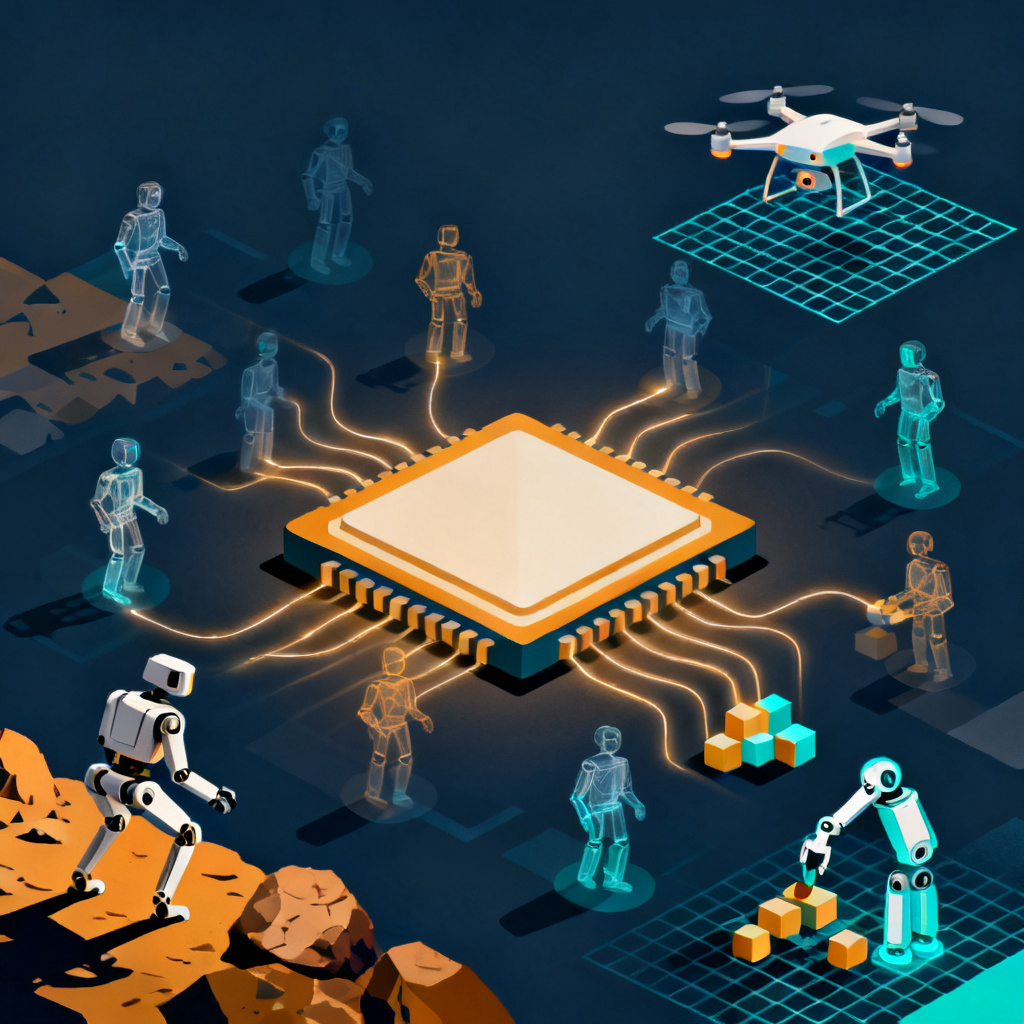
Illustration brief the model wrote
A large rectangular GPU chip at the center, with glowing threads connecting to dozens of small robot avatars in different virtual environments: a legged robot on rocky ground, a robot arm assembling blocks, a drone hovering over a grid. Robots are semi-transparent wireframe to indicate simulation. No text or logos.
Isaac Lab: A GPU-Accelerated Simulation Framework for Multi-Modal Robot Learning
NVIDIA’s successor to Isaac Gym provides a single composable GPU-accelerated framework for physics, rendering, and sensor simulation for robot learning.
What changed
ModelPrevious robot simulators often required separate pipelines for physics, rendering, and sensor modeling, limiting parallelism and speed. Isaac Lab unifies these on a single GPU kernel, enabling thousands of parallel environments and reducing training time from weeks to hours.
So what, in plain English
ModelTraining a robot to walk or grasp used to take days or weeks of computer time because only one or a few simulations could run at once. Isaac Lab lets a single GPU run thousands of simulated robots simultaneously, so training happens in hours.
Contribution to industry
ModelIsaac Lab has become the standard training substrate for NVIDIA's robot learning research and is used by robotics teams for whole-body, locomotion, and dexterous policy development. It directly feeds into deployments via NVIDIA's Isaac Sim and Omniverse platforms.
Typed judgments
Jev★★★★☆ simulation · Physical AI 96%
Real hardware 11% · Open code / data 27% · Foundation-model based 5% · Survey / benchmark-only 4%
Probabilities from TypeSafe Jev over the title, venue and abstract; the filters on the atlas apply code-owned thresholds to these numbers.
Editor's notes
Summary. NVIDIA’s successor to Isaac Gym: GPU-parallel physics, photorealistic rendering, actuator and multi-frequency sensor models, data collection and domain randomization unified in one composable framework for reinforcement and imitation learning at scale.
Industry. Became the de-facto training substrate for robot learning, letting teams train whole-body, locomotion and dexterous policies in hours of wall-clock instead of weeks.