Illustration brief the model wrote
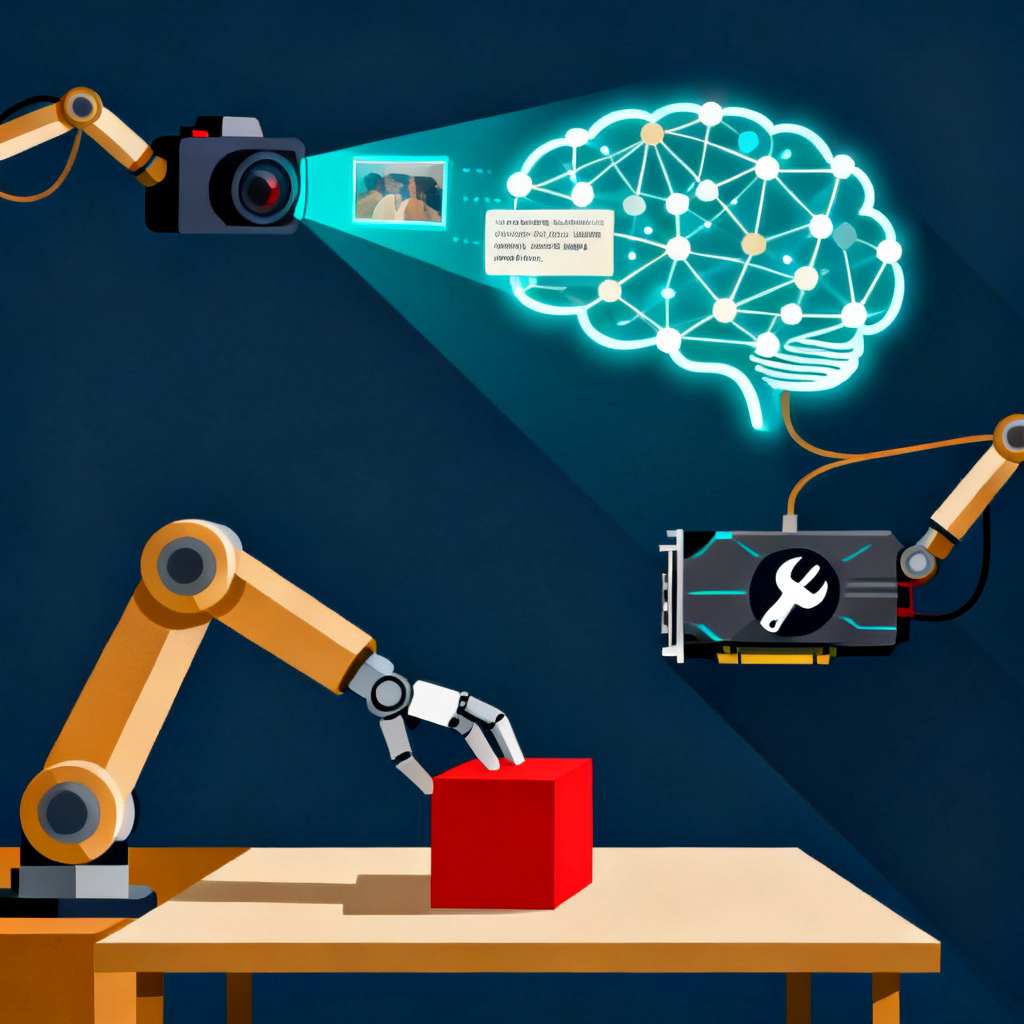
A robotic arm reaching for a red block on a table while a glowing network diagram above shows a camera feeding images and text instructions into a brain-like cluster of nodes. Another arm on the side is connected to a consumer GPU with a wrench symbol, indicating fine-tuning.
OpenVLA: An Open-Source Vision-Language-Action Model
OpenVLA is a 7B open-weight vision-language-action model trained on 970k robot episodes, enabling fine-tuning for new tasks with modest compute.
What changed
ModelBefore OpenVLA, powerful robot foundation models were proprietary and required extensive resources. This paper introduced an open 7B model trained on a large multi-embodiment dataset, making fine-tuning feasible on consumer GPUs.
So what, in plain English
ModelThink of OpenVLA as a robot 'brain' that can learn to control many different robots by watching lots of examples. Before, each robot needed its own custom program; now you can download a general brain and teach it new skills with just a few demos on a gaming computer.
Contribution to industry
ModelThe model provides an inspectable alternative to closed-source robot models, accelerating research and prototyping. It contributes a pre-trained checkpoint and fine-tuning pipeline using the Open X-Embodiment dataset, enabling startups and labs to build specialized robotic systems without massive budgets.
Typed judgments
Jev★★★★☆ robots · Physical AI 98%
Real hardware 66% · Open code / data 67% · Foundation-model based 93% · Survey / benchmark-only 3%
Probabilities from TypeSafe Jev over the title, venue and abstract; the filters on the atlas apply code-owned thresholds to these numbers.
Editor's notes
Summary. A 7B open-weight vision-language-action model trained on about 970,000 robot episodes from Open X-Embodiment, fine-tunable to new tasks and embodiments with modest compute.
Industry. Gave industry and academia an affordable, inspectable alternative to proprietary robot models, with fine-tuning feasible on consumer GPUs.