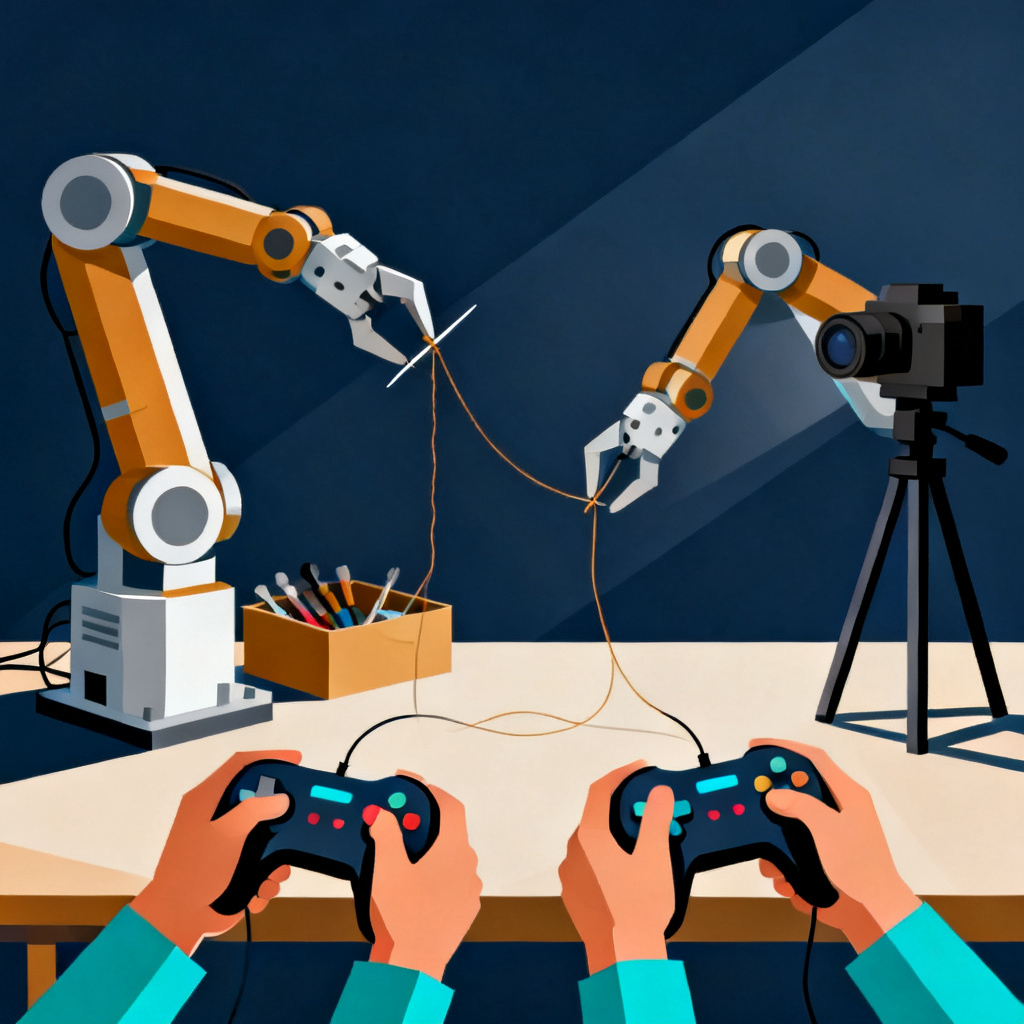
Illustration brief the model wrote
Two low-cost robot arms with grippers teleoperated by a human holding two joystick-like controllers. The arms perform a threading task: one arm holds a needle, the other holds a thread. A camera on a tripod observes. Background shows a simple workspace with a box of tools.
Learning Fine-Grained Bimanual Manipulation with Low-Cost Hardware
Presents ALOHA, a low-cost bimanual teleoperation rig and ACT algorithm for learning fine-grained bimanual manipulation tasks.
What changed
ModelBefore this paper, fine-grained bimanual manipulation required expensive industrial robot arms (over $100k). The paper introduced ALOHA, an open-source, low-cost system (under $20k), and ACT, a transformer-based algorithm that learns precise actions from limited demonstrations, making high-quality bimanual data collection accessible.
So what, in plain English
ModelThis paper shows how to teach two robot arms to do delicate tasks like threading a needle or opening a tricky container using cheap parts and a smart AI method. It's like teaching a friend to cook by letting them watch your hands and practice the same movements.
Contribution to industry
ModelThe ALOHA hardware design and ACT algorithm became a widely copied baseline for bimanual manipulation research. Startups and academic labs adopted the platform for data collection and policy learning, reducing hardware costs from over $100,000 to under $20,000. The system has been used in subsequent works for tasks like folding clothes and assembling parts.
Typed judgments
Jev★★★★☆ manipulation · Physical AI 98%
Real hardware 91% · Open code / data 24% · Foundation-model based 13% · Survey / benchmark-only 2%
Probabilities from TypeSafe Jev over the title, venue and abstract; the filters on the atlas apply code-owned thresholds to these numbers.
Editor's notes
Summary. Presents ALOHA, a low-cost bimanual teleoperation rig, plus Action Chunking with Transformers, which learns fine-grained tasks such as threading, slotting and opening translucent objects.
Industry. The hardware design and ACT algorithm were widely copied, letting small teams and startups collect high-quality manipulation data without six-figure robot arms.