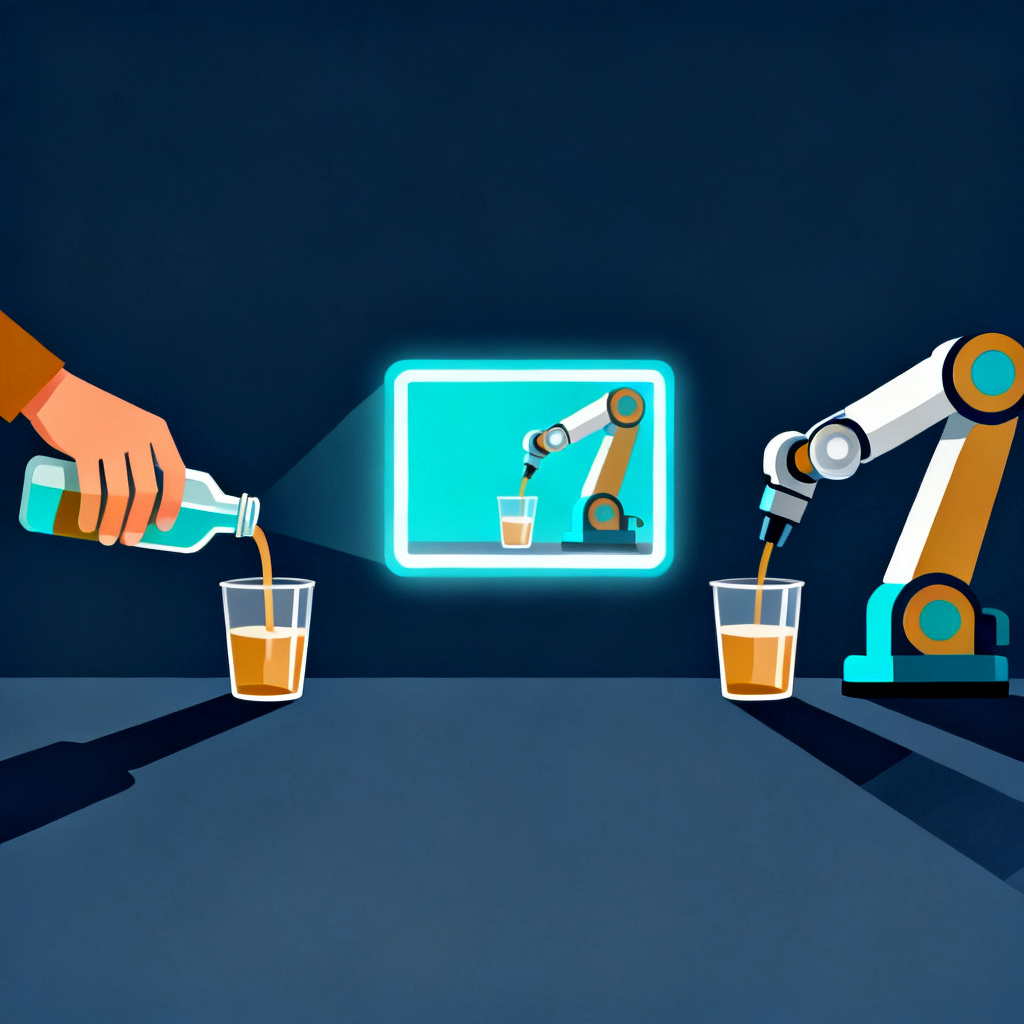
Illustration brief the model wrote
Left: a human hand pouring liquid from a bottle into a clear cup. Right: a robot arm and identical cup. Between them, a glowing video frame shows the robot arm performing the same pouring motion. No text or logos.
Dreamitate: Real-World Visuomotor Policy Learning via Video Generation
Fine-tunes video diffusion on human demos, uses generated video to control robot in new scenes, bridging human-robot gap.
What changed
ModelBefore this paper, visuomotor policies required many demonstrations per task and scene, with limited generalization. This paper shows that a single human demonstration can condition a fine-tuned video diffusion model to generate a robot execution video for a novel scene, and the robot can execute by tracking that generated video, dramatically reducing the number of demos needed and enabling zero-shot deployment in new environments.
So what, in plain English
ModelInstead of programming a robot or showing it thousands of examples, you can show it a video of a human doing a task once. The robot then imagines a video of itself doing that same task in a new place, and follows that imaginary video to actually do it—like watching a chef, then imagining yourself cooking in your own kitchen, then following that imagination step by step.
Contribution to industry
ModelThis paper contributed a method that turns internet-scale video generators into policy engines, cutting the demonstrations needed to deploy a known task in a new environment. It suggests a path toward generalist robot skill learning with minimal data collection, relevant for manufacturing and home robotics. Toyota Research Institute may use this to accelerate robotic deployment in unstructured settings.
Typed judgments
Jev★★★☆☆ robots · Physical AI 95%
Real hardware 73% · Open code / data 10% · Foundation-model based 94% · Survey / benchmark-only 3%
Probabilities from TypeSafe Jev over the title, venue and abstract; the filters on the atlas apply code-owned thresholds to these numbers.
Editor's notes
Summary. Fine-tunes a video diffusion model on human demonstrations (CoRL 2024), generates an imagined execution conditioned on images of a novel scene, and uses that video directly to control the robot, with common tools bridging the human-to-robot gap.
Industry. Showed internet-scale video generators can serve as policy engines, cutting the demonstrations needed to deploy a known task in a new environment.