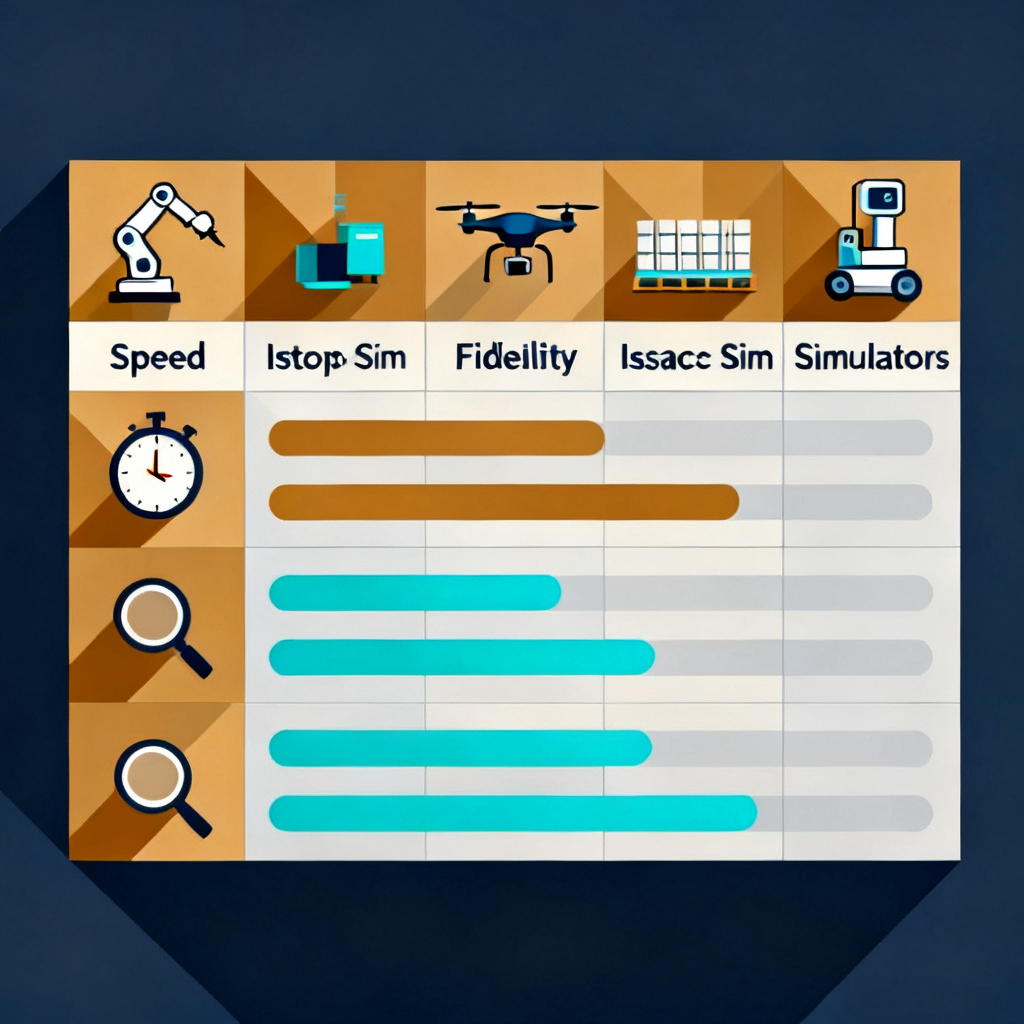
Illustration brief the model wrote
A side-by-side comparison grid: five columns each labeled with an icon (e.g., robotic arm, drone, warehouse robot). Rows show speed (stopwatch) and fidelity (magnifying glass) bars for Isaac Sim and three other simulators. No text, only icons and color-coded bars.
NVIDIA Isaac Sim: Enabling Scalable, GPU-Accelerated Simulation for Robotics
Independent survey reviews Isaac Sim's architecture, compares with other simulators across five robotics domains, and analyses practical limits.
What changed
ModelBefore this paper, GPU-accelerated simulation comparisons were often vendor-driven or anecdotal. This paper provides an independent, structured evaluation that maps where Isaac Sim outperforms alternatives and where its limitations lie, enabling evidence-based simulator selection.
So what, in plain English
ModelThink of it like a car review that tests different vehicles on highway vs. city driving. This paper tests Isaac Sim against other robot simulators across five different tasks, so engineers know which simulator saves time and gives accurate results for their specific robot project.
Contribution to industry
ModelThe paper gives robotics engineering teams a clear decision framework for choosing simulation tools, reducing guesswork and hardware investment risk. It is used by product teams to optimize simulation pipelines for manipulation, navigation, and other domains, shortening development cycles.
Typed judgments
Jev★☆☆☆☆ simulation · Physical AI 57%
Real hardware 11% · Open code / data 5% · Foundation-model based 5% · Survey / benchmark-only 92%
Probabilities from TypeSafe Jev over the title, venue and abstract; the filters on the atlas apply code-owned thresholds to these numbers.
Editor's notes
Summary. An independent survey by external (UNSW) authors, not an NVIDIA publication: it reviews Isaac Sim’s architecture, compares it with other simulators, and analyses representative usage across five domains plus practical limits.
Industry. Gives engineering teams an evidence-based map of where GPU simulation pays off, shortening simulator and digital-twin decisions before hardware investment.