Illustration brief the model wrote
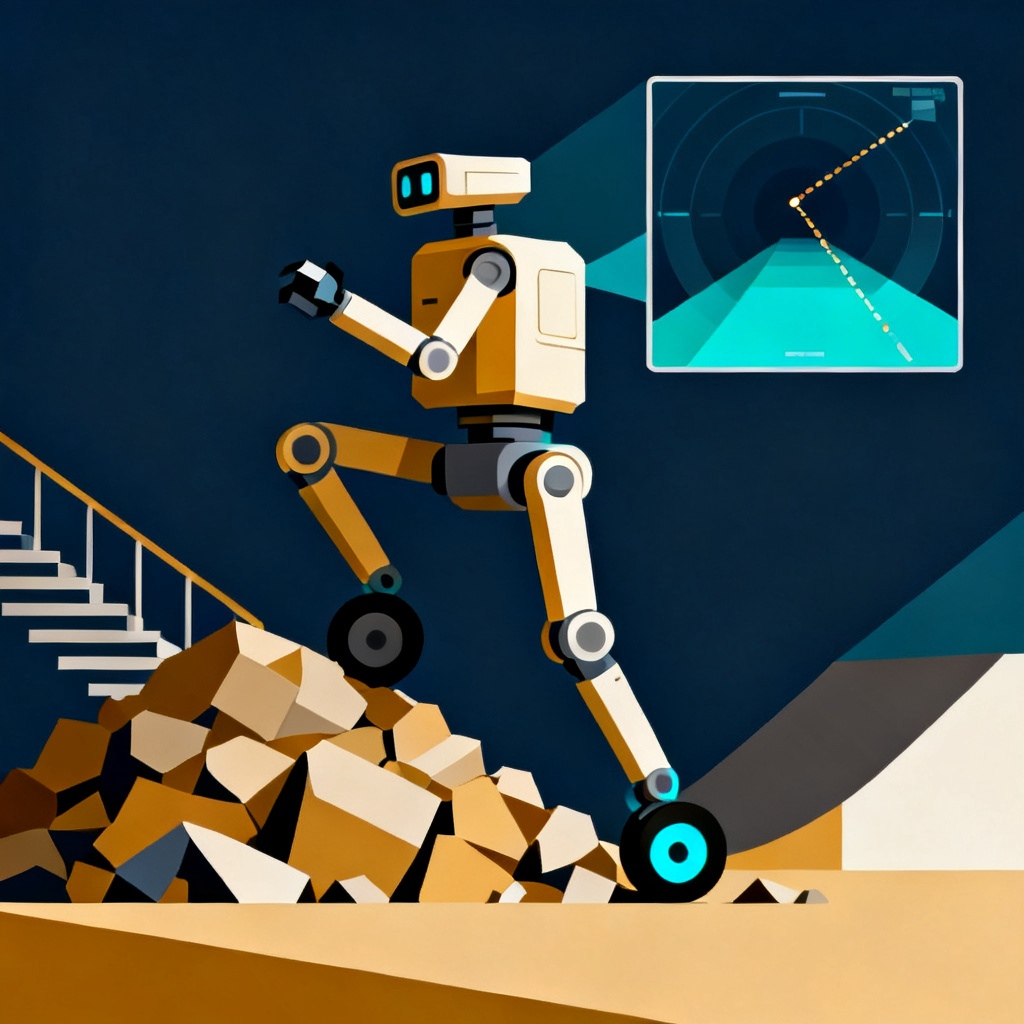
A wheeled-legged robot ascending a rubble pile, one leg raised, wheels half-retracted. In the background, a staircase and a ramp. An inset shows a first-person camera view with a trajectory path and depth cues. No text, letters, logos, or human faces.
Learning Robust Autonomous Navigation and Locomotion for Wheeled-Legged Robots
Learns robust autonomous navigation and locomotion for wheeled-legged robots using onboard vision and proprioception.
What changed
ModelBefore, wheeled-legged robots relied on separate, manually tuned controllers for navigation and locomotion, limiting their autonomy in complex terrain. This paper introduces a single end-to-end learned policy that jointly handles both tasks using only onboard sensors, enabling autonomous traversal of stairs, ramps, rubble, and urban environments.
So what, in plain English
ModelImagine a robot with wheels and legs that previously needed a separate driver and mover; now it learns to see and move as one skill, like a person who can plan a forest path and walk it without thinking. This makes wheeled-legged robots much more capable of handling messy real-world places without human help.
Contribution to industry
ModelThis paper contributes a learning framework that integrates vision and proprioception for wheeled-legged robots, making them viable for last-mile delivery, industrial inspection, and disaster response. It shows autonomous traversal of challenging terrain without external infrastructure, providing a scalable approach for companies like ANYbotics to deploy hybrid robots in unstructured environments.
Typed judgments
Jev★★★☆☆ locomotion · Physical AI 98%
Real hardware 69% · Open code / data 8% · Foundation-model based 14% · Survey / benchmark-only 5%
Probabilities from TypeSafe Jev over the title, venue and abstract; the filters on the atlas apply code-owned thresholds to these numbers.
Editor's notes
Summary. Learns a combined navigation and locomotion stack for wheeled-legged robots that autonomously traverses stairs, ramps, rubble and urban terrain using onboard vision and proprioception.
Industry. Makes wheeled-legged platforms credible for last-mile delivery, inspection and disaster response, where mixed terrain defeats wheeled-only and legged-only designs.