Illustration brief the model wrote
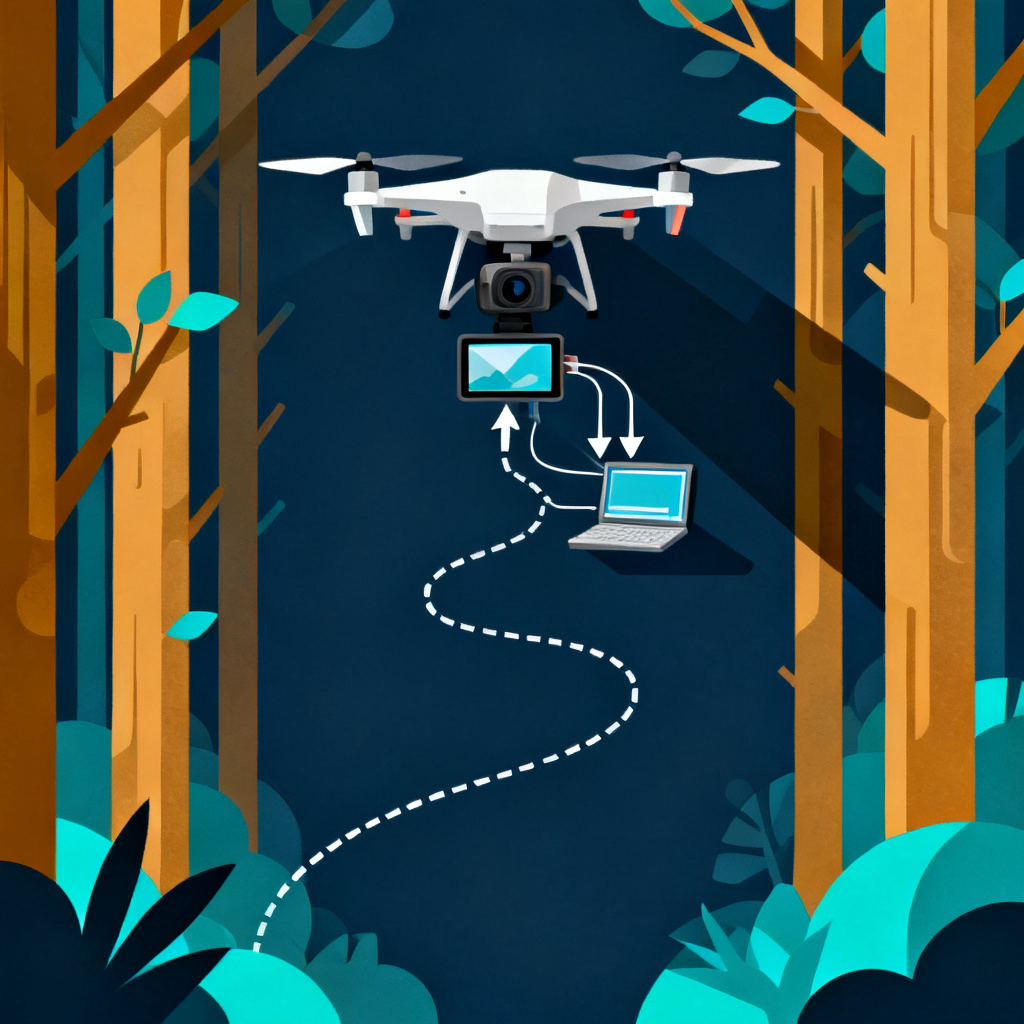
A quadrotor drone flying through a dense forest with tree trunks and branches on both sides; a camera mounted on the drone's front captures the scene; arrows from the camera to the onboard computer represent real-time processing; the drone's trajectory is shown as a curving dashed line weaving between obstacles.
Learning High-Speed Flight in the Wild
Trains a neural network to fly a quadrotor at high speed through forest trails using only onboard vision and no pre-built map.
What changed
ModelBefore this paper, high-speed autonomous flight in cluttered outdoor environments relied on motion-capture systems or pre-built maps. The paper demonstrated that an end-to-end learned policy from raw images can achieve similar performance, enabling drones to fly through unknown, unstructured terrain without external infrastructure.
So what, in plain English
ModelThink of a drone that learns to fly through a dense forest like a bird, using only its eyes and brain, instead of needing a detailed map of the forest's trees beforehand. This makes drones much more capable of navigating new places quickly and safely.
Contribution to industry
ModelThis paper popularized vision-based end-to-end learning for drone autonomy, leading to its adoption in commercial inspection drones and autonomous systems for defense. The open-source release of code and trained models allowed startups and researchers to build custom navigation systems without expensive hardware, and companies like Skydio incorporated similar approaches into their products.
Typed judgments
Jev★★★★☆ drones · Physical AI 98%
Real hardware 86% · Open code / data 12% · Foundation-model based 7% · Survey / benchmark-only 3%
Probabilities from TypeSafe Jev over the title, venue and abstract; the filters on the atlas apply code-owned thresholds to these numbers.
Editor's notes
Summary. Trains a vision-based policy that flies a quadrotor at high speed through cluttered forest trails using onboard sensing only, with no map and no external motion capture.
Industry. Showed onboard end-to-end learning can replace map-and-plan pipelines for drones, the basis of much of today’s autonomous inspection and defence drone autonomy.