Illustration brief the model wrote
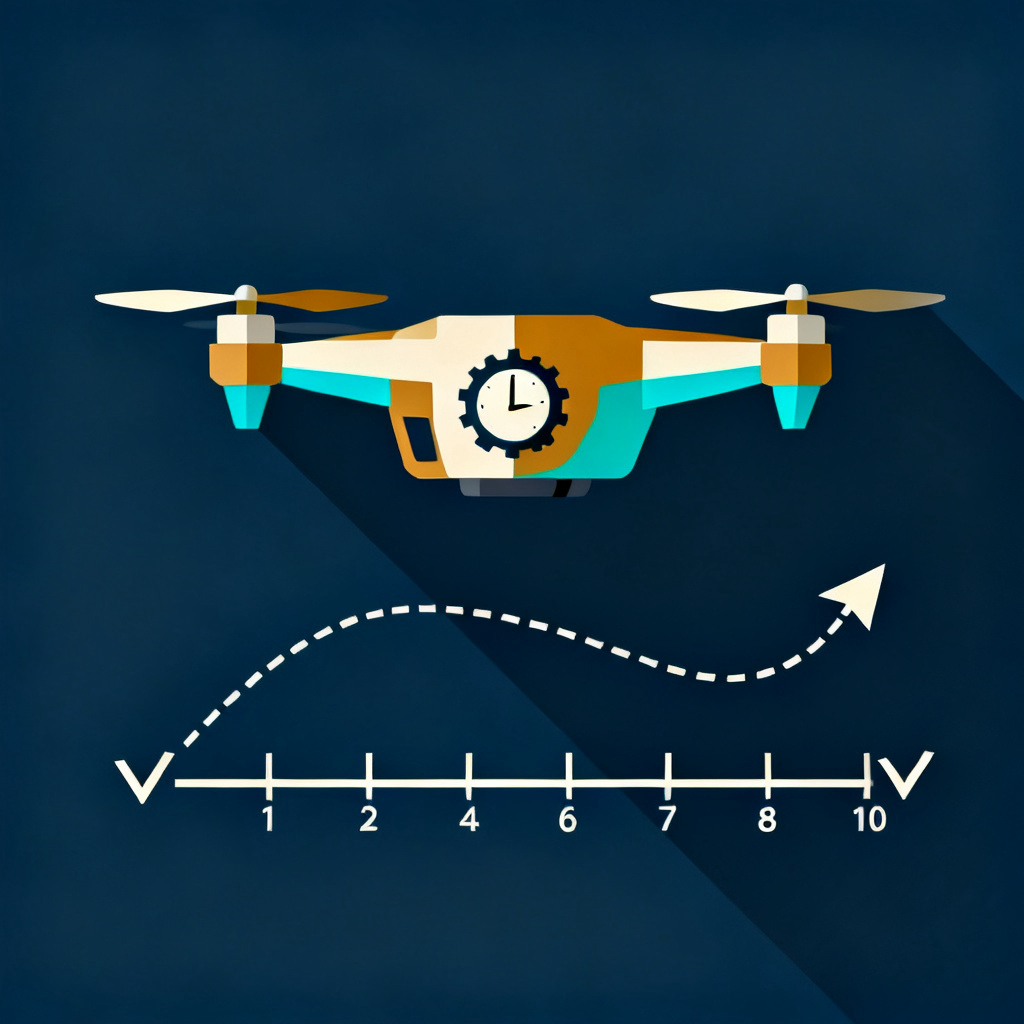
A quadrotor drone with a clock gear icon on its side flies left to right. Below it, a number line with tick marks labeled 1.9 increasing to 7.3. A dashed arrow labeled 'residual' adjusts the drone's trajectory mid-flight, while a second arrow labeled 'temporal scaling' stretches the path between waypoints.
Learning Agile Quadrotor Flight in the Real World
Adaptive temporal scaling and online residual learning achieve 7.3 m/s agile quadrotor flight in 100 seconds.
What changed
ModelPreviously, agile quadrotor flight required precise system identification or extensive sim-to-real transfer. This paper removes those needs by using adaptive temporal scaling to explore the platform's physical limits and online residual learning with in-flight policy updates, raising speed from 1.9 m/s to 7.3 m/s in about 100 seconds.
So what, in plain English
ModelImagine learning to ride a bike by starting slowly and gradually pedaling faster, adjusting your balance in real time—no need for a perfect manual first. This lets drones learn to fly faster and more aggressively just by practicing in the real world, without expensive simulation or calibration.
Contribution to industry
ModelThe paper replaces fragile system identification pipelines with in-flight adaptation, enabling drone vendors to continuously improve aggressive flight performance after deployment. This contributes a practical, deployment-ready method for real-world reinforcement learning on physical quadrotors, directly usable by robotics and drone companies.
Typed judgments
Jev★★★☆☆ drones · Physical AI 98%
Real hardware 95% · Open code / data 6% · Foundation-model based 5% · Survey / benchmark-only 3%
Probabilities from TypeSafe Jev over the title, venue and abstract; the filters on the atlas apply code-owned thresholds to these numbers.
Editor's notes
Summary. Removes the need for precise system identification or offline sim-to-real transfer: adaptive temporal scaling explores the platform’s physical limits while online residual learning and in-flight policy updates raise a conservative 1.9 m/s policy to 7.3 m/s in about 100 seconds of flight.
Industry. Replaces fragile identification pipelines with in-flight adaptation, letting drone vendors keep improving aggressive flight performance after deployment.