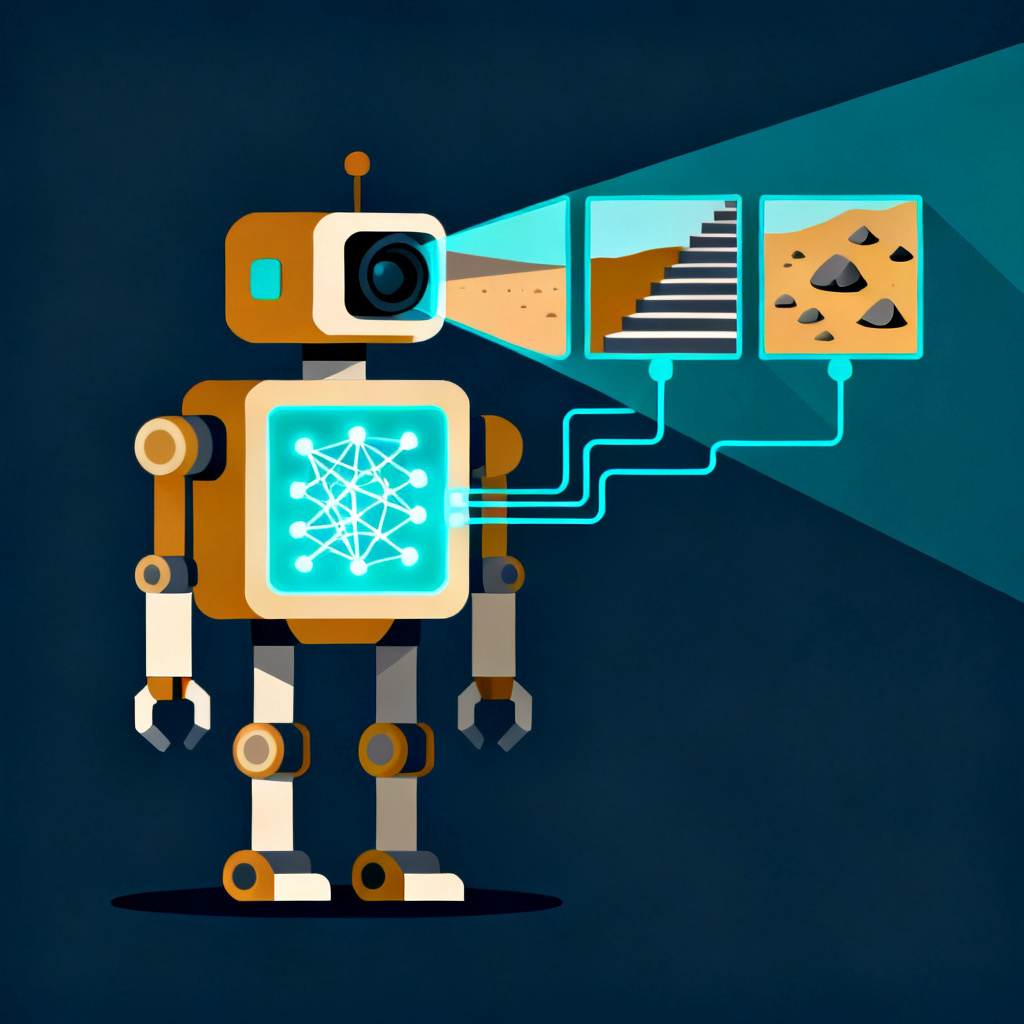
Illustration brief the model wrote
A robot with a camera on its head, a glowing neural network inside its torso directly connected to its leg motors. The camera shows three different terrains (flat ground, stairs, scattered rocks) side by side, all feeding into the same network with no separate boxes for mapping or planning.
One Model, Any Scenario: End-to-end Locomotion from Vision
A vision-to-motor policy that handles walking, stairs, and obstacles without mapping or behavior switching.
What changed
ModelBefore, locomotion required separate controllers or explicit mapping and planning for each terrain type. This paper shows a single hierarchical policy can generalize across diverse scenarios directly from raw camera images and joint feedback, eliminating the need for terrain-specific software modules.
So what, in plain English
ModelImagine a remote that works for your TV, stereo, and lights instead of needing a different one for each device. This paper builds a robot that uses one brain to handle flat ground, stairs, and cluttered paths without being told which is coming next.
Contribution to industry
ModelFor robot vendors, this replaces multiple terrain-specific locomotion stacks with one learned model, simplifying deployment and reducing development time. Skild AI contributes this as part of their platform, enabling general-purpose robots that adapt on the fly without manual tuning or environment-specific code.
Typed judgments
Jev★★★☆☆ locomotion · Physical AI 96%
Real hardware 50% · Open code / data 7% · Foundation-model based 14% · Survey / benchmark-only 3%
Probabilities from TypeSafe Jev over the title, venue and abstract; the filters on the atlas apply code-owned thresholds to these numbers.
Editor's notes
Summary. A hierarchical vision-driven policy whose low-level network turns raw images and joint feedback directly into motor commands, so one model walks, climbs stairs and steps over obstacles with no mapping, planning or behaviour switching.
Industry. Shows one learned controller can replace terrain-specific locomotion software, which is what lets robot vendors sell a general-purpose machine rather than a site-specific one.