Illustration brief the model wrote
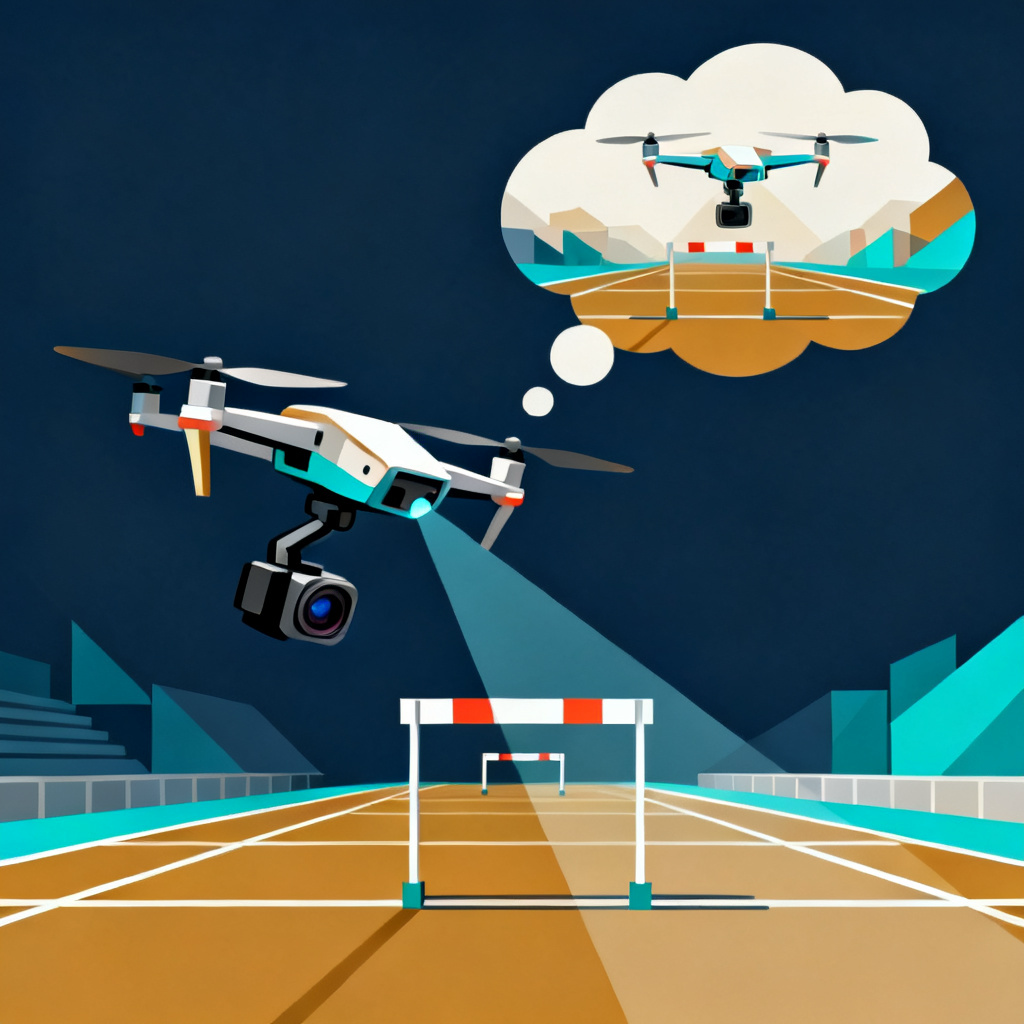
A drone with a camera on a gimbal flying through a gate. The drone's body is tilted, camera pointed toward the next gate. Background shows a simple racing course with gates. A thought bubble above the drone shows a simulated (dream) version of the same scene.
Dream to Fly: Model-Based Reinforcement Learning for Vision-Based Drone Flight
Applies DreamerV3 model-based RL to learn vision-based drone racing policies from pixels, reaching 9 m/s on real hardware with emergent gate-tracking.
What changed
ModelBefore this paper, model-free RL methods required large amounts of real-world data or complex sim-to-real transfers for drone racing. This paper shows that model-based RL (DreamerV3) can learn directly from pixels in simulation and transfer to real flight, achieving agile speeds with learned camera orientation behavior.
So what, in plain English
ModelDrones usually need explicit programming or tons of real-world practice to learn to race. This paper shows a drone can learn to fly fast by first dreaming about flying in a simulator, then waking up and doing it for real, even steering its camera to look at gates automatically.
Contribution to industry
ModelContributed a practical method for learning drone racing policies with moderate compute/data, demonstrating model-based RL as a viable alternative to model-free methods for agile autonomy. Research labs and companies developing autonomous drones for inspection, delivery, or racing can use this approach to train policies efficiently in simulation before deploying on real hardware.
Typed judgments
Jev★★★☆☆ drones · Physical AI 97%
Real hardware 95% · Open code / data 10% · Foundation-model based 17% · Survey / benchmark-only 6%
Probabilities from TypeSafe Jev over the title, venue and abstract; the filters on the atlas apply code-owned thresholds to these numbers.
Editor's notes
Summary. Uses DreamerV3 model-based RL to learn pixel-to-command drone racing policies, emerging with camera-pointing behaviour that keeps gates in view, and flying real hardware up to 9 m/s.
Industry. Positions model-based RL as a practical route to agile autonomy for teams whose data and compute budgets are far smaller than model-free methods require.