Illustration brief the model wrote
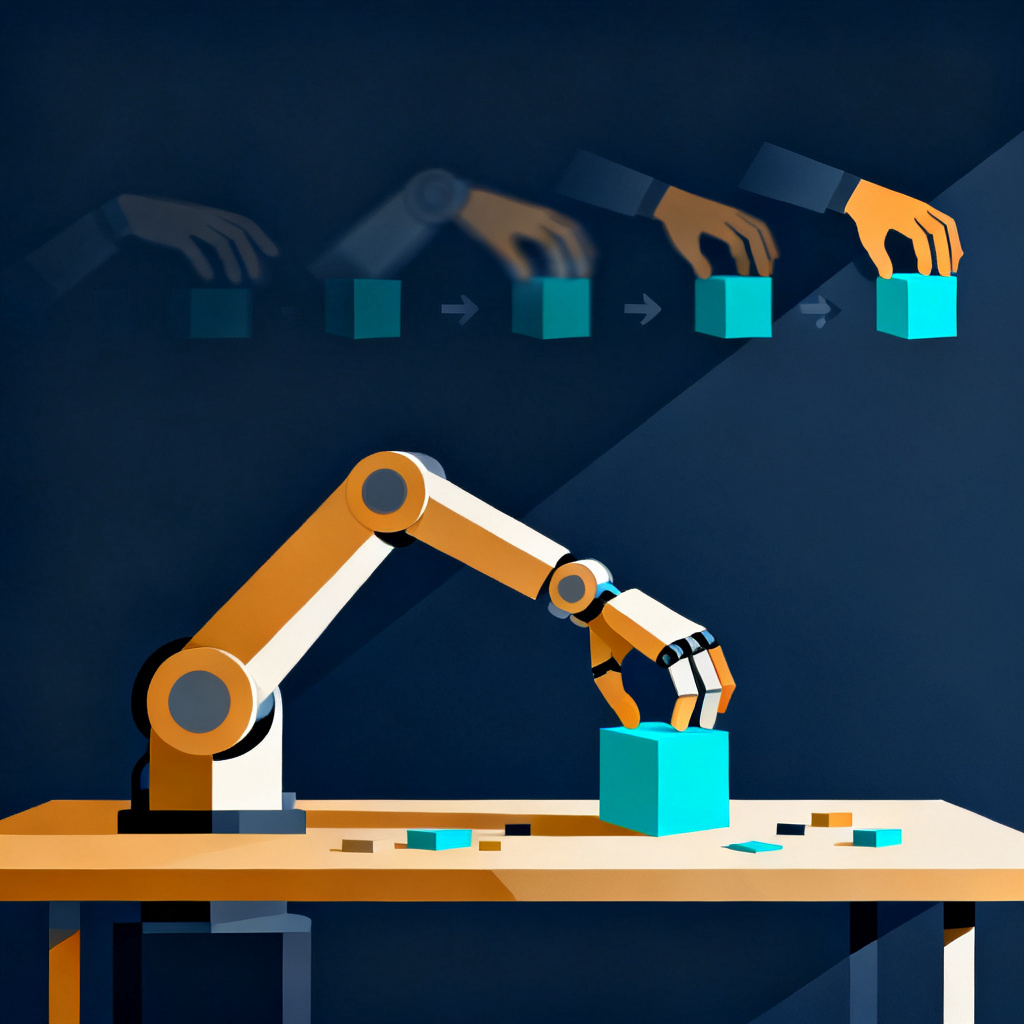
A robot arm reaching toward a table with scattered objects. Above the arm, a sequence of blurry action ghosts (posed hands) progressively sharpens into a clear final grip on a cube, showing denoising steps.
Diffusion Policy: Visuomotor Policy Learning via Action Diffusion
Represents a visuomotor policy as a denoising diffusion process over action sequences conditioned on observations, handling multimodal demonstrations and high-frequency control.
What changed
ModelBefore, robot policies often struggled with multimodal action distributions and required careful smoothing or separate networks. Diffusion policy treats action generation as iterative denoising, naturally capturing multimodality and enabling stable high-frequency control. It became a default approach for imitation learning in robotics.
So what, in plain English
ModelImagine a robot learning to pour milk by watching many different ways. Diffusion policy lets the robot choose the right way for each situation, like a chef picking from many recipes, by gradually refining a messy guess into a smooth, precise action.
Contribution to industry
ModelThis paper became a default algorithm in commercial manipulation stacks and open-source robot learning libraries like Robosuite. It is widely used for training robots from demonstration data in research and early deployments, especially for dexterous manipulation tasks, and many follow-up works build on it as a backbone.
Typed judgments
Jev★★★★★ robots (also manipulation) · Physical AI 97%
Real hardware 78% · Open code / data 26% · Foundation-model based 10% · Survey / benchmark-only 2%
Probabilities from TypeSafe Jev over the title, venue and abstract; the filters on the atlas apply code-owned thresholds to these numbers.
Editor's notes
Summary. Represents a visuomotor policy as a denoising diffusion process over action sequences conditioned on observations, handling multimodal demonstrations and high-frequency control.
Industry. Became a default imitation-learning algorithm in both commercial manipulation stacks and open-source robot-learning libraries.