Illustration brief the model wrote
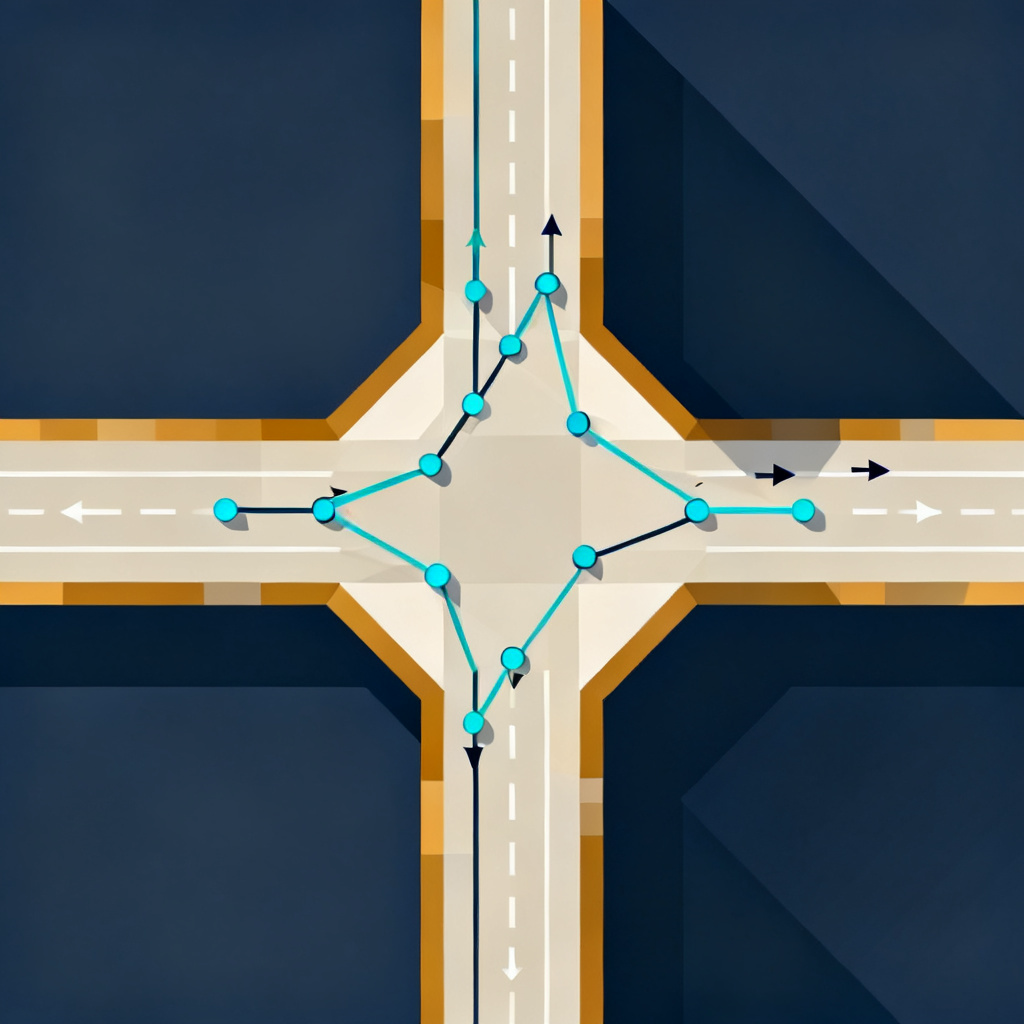
A bird's-eye view of a road intersection with connected polylines for lanes and road edges. Small directional arrows representing agent trajectories connect to nodes along the polylines, forming a sparse graph. No pixel grid, no text, no faces, no logos.
VectorNet: Encoding HD Maps and Agent Dynamics from Vectorized Representation
Replaces raster HD maps with vectorized graph nodes for efficient agent trajectory prediction.
What changed
ModelBefore, motion prediction used rasterized bird's-eye view image stacks, which were compute-intensive and lost geometric precision. VectorNet introduced encoding HD map elements and agent trajectories as vectorized polylines and points, processed by a graph neural network, enabling direct geometric reasoning with lower compute and improved accuracy.
So what, in plain English
ModelInstead of drawing the road as a heavy pixel image, you draw it as connected lines and points like a wireframe. This makes it faster and easier for a computer to figure out where cars and people will go next.
Contribution to industry
ModelVectorNet became a standard representation in autonomous driving trajectory prediction stacks, cutting compute while improving prediction accuracy. It influenced subsequent models like LaneGCN and HDMapNet, and is used by Waymo and other AV companies for efficient fusion of map and agent data.
Typed judgments
Jev★★★★☆ autonomy · Physical AI 96%
Real hardware 12% · Open code / data 12% · Foundation-model based 4% · Survey / benchmark-only 2%
Probabilities from TypeSafe Jev over the title, venue and abstract; the filters on the atlas apply code-owned thresholds to these numbers.
Editor's notes
Summary. Encodes HD map elements and agent trajectories as vectorized graph nodes processed by a graph neural network, replacing rasterized image stacks for motion prediction.
Industry. Became a standard trajectory-prediction representation in autonomous driving and mobile robotics stacks, cutting compute while improving prediction accuracy.