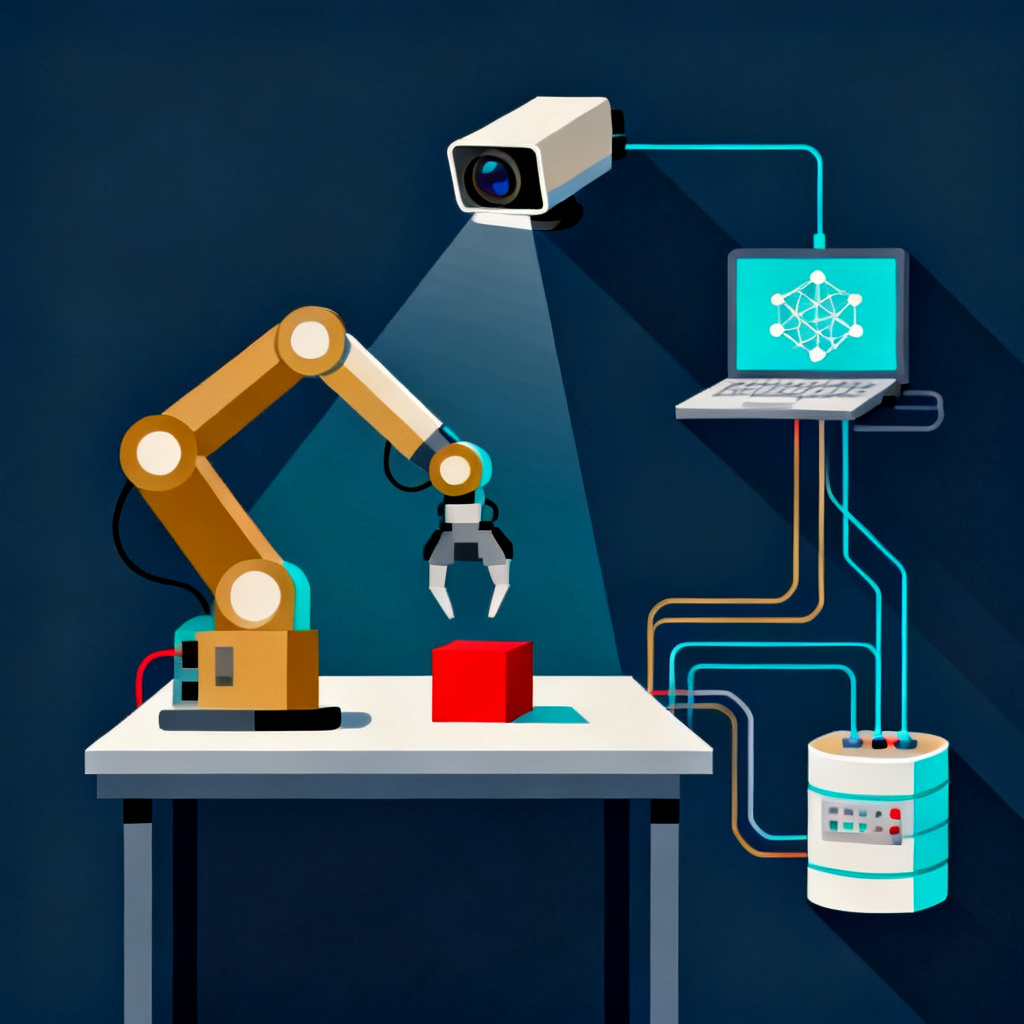
Illustration brief the model wrote
A modular robot arm on a lab bench picks up a red block. A camera above streams images to a small computer running a neural network. Lines show data flowing from the camera to a database, then to a control box that sends signals to the arm's motors. No humans, no text, no logos.
LeRobot: An Open-Source Library for End-to-End Robot Learning
An open-source library covering the full robot learning pipeline: motor middleware, dataset collection/streaming, imitation/RL algorithms, and inference on accessible hardware.
What changed
ModelPreviously, robot learning required proprietary pipelines and expensive hardware, limiting accessibility. LeRobot provides a standardized open library that unifies the entire stack, enabling implementation on affordable robots. This democratizes development for startups and industrial users.
So what, in plain English
ModelLeRobot is like a complete toolkit that lets you build and train your own robot assistants using off-the-shelf parts, similar to how open-source software frameworks made smartphone app development accessible to everyone. Researchers and hobbyists can now focus on teaching robots new skills instead of building the underlying infrastructure from scratch.
Contribution to industry
ModelThe library provides a unified platform for dataset collection and algorithm implementation, enabling rapid prototyping of robot skills on low-cost hardware. It includes standard benchmarks and pretrained models, reducing development time for startups and manufacturing facilities. Industrial users can deploy manipulation and navigation tasks on affordable robot arms and mobile bases without proprietary pipelines.
Typed judgments
Jev★★★★☆ robots · Physical AI 90%
Real hardware 42% · Open code / data 65% · Foundation-model based 32% · Survey / benchmark-only 7%
Probabilities from TypeSafe Jev over the title, venue and abstract; the filters on the atlas apply code-owned thresholds to these numbers.
Editor's notes
Summary. An open library spanning the whole robot learning stack: low-level motor middleware, large-scale dataset collection, storage and streaming, state-of-the-art imitation and RL algorithms, and asynchronous inference on accessible hardware.
Industry. Standardized open infrastructure that lets startups and factories build custom robot skills without proprietary pipelines or six-figure platforms.