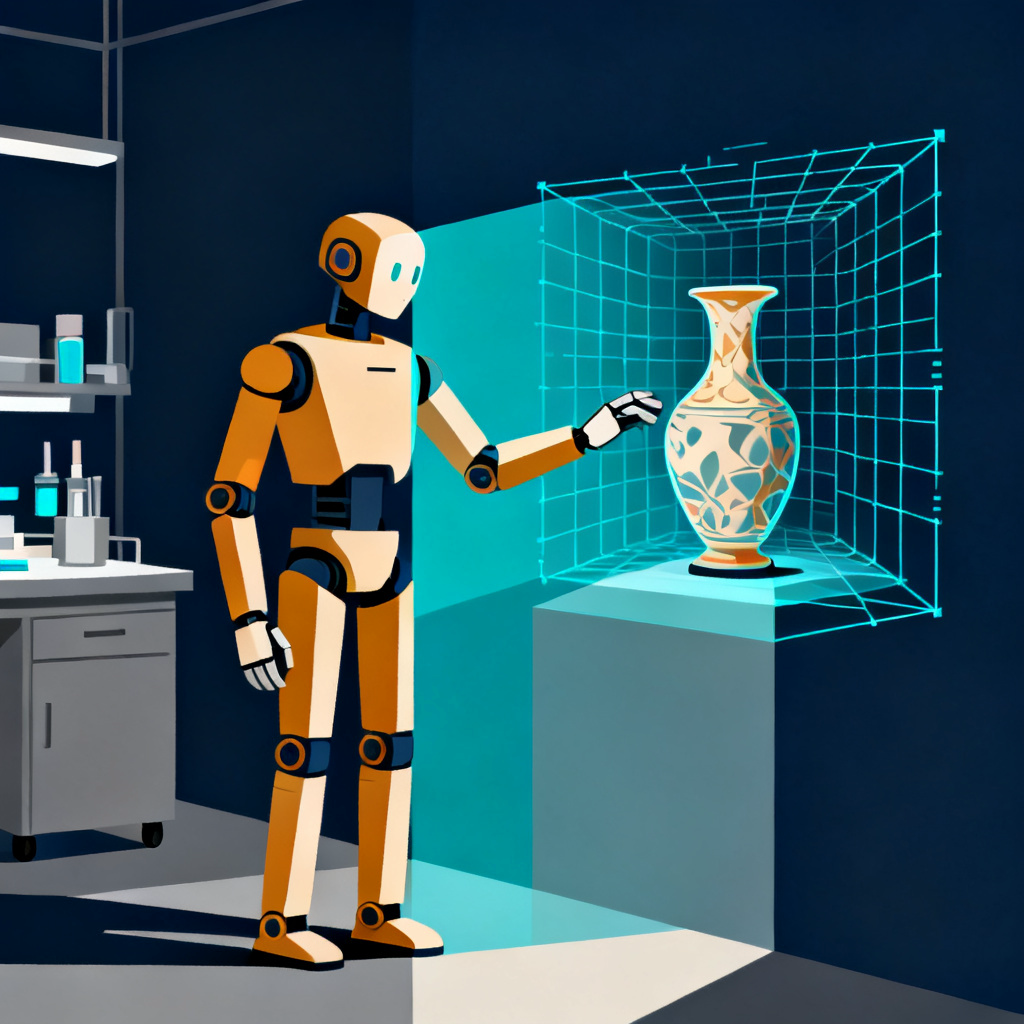
Illustration brief the model wrote
A humanoid robot in a gray lab, its right side fading into a digital wireframe grid. Reaching toward a fragile vase, the real half stops short while the digital half continues, showing the vase safe in simulation.
1X World Model: Evaluating Bits, not Atoms
Trains a video world model on humanoid data to evaluate policies in simulation, predicting real-world task success without hardware.
What changed
ModelBefore, evaluating humanoid policies required expensive and risky physical hardware runs. This paper shows that a learned world model can accurately predict real-world task success from video generation, enabling screening of rare and hazardous situations without risking hardware.
So what, in plain English
ModelWorld models let engineers test robot actions in a video simulation before trying them on a real robot, like testing a stunt in a video game before performing it in real life. This cuts the cost and danger of physical trials.
Contribution to industry
ModelThis paper contributed a method for evaluating humanoid policies using a generative video world model, reducing the time and cost of physical evaluation. Robotics companies deploying humanoid platforms can now safely test edge cases and rare events without endangering hardware. The dataset and model are built from 1X's own humanoid teleoperation data.
Typed judgments
Jev★★★☆☆ simulation · Physical AI 93%
Real hardware 11% · Open code / data 9% · Foundation-model based 72% · Survey / benchmark-only 5%
Probabilities from TypeSafe Jev over the title, venue and abstract; the filters on the atlas apply code-owned thresholds to these numbers.
Editor's notes
Summary. Trains a video-generation world model on humanoid data and evaluates policies inside it — "evaluating bits, not atoms" — to predict real-world task success before any hardware runs.
Industry. Lets teams screen humanoid policies against rare and hazardous situations without risking hardware, cutting the cost and time of physical evaluation.